
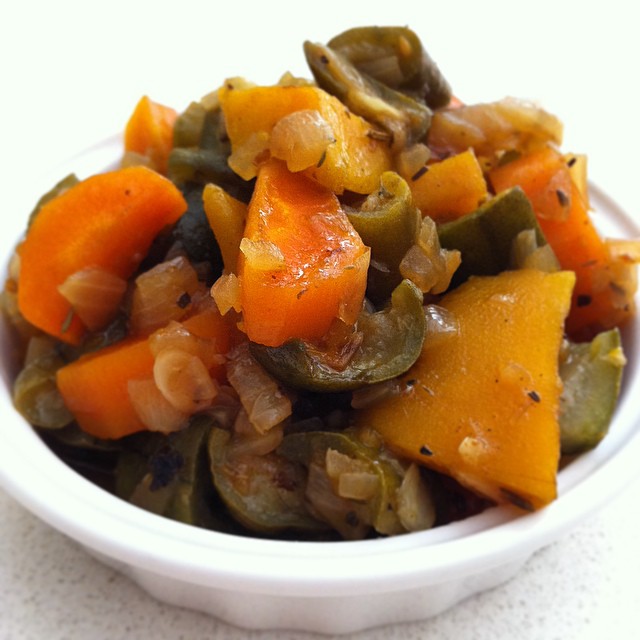
My ratatouille inspired farm-to-table lunch of organic greens
Farm-to-table (or farm-to-fork), one of many food movements in today’s health conscious culture, focuses on producing food locally and delivering that food to local consumers. It is often associated with organic farming initiatives, sustainable agriculture, and community-supported agriculture. While it has been gaining popularity in other parts of the world, in Singapore, this is still largely unheard of among most of the locals.
Little surprise there since according to AVA, Singapore imports some 90% of our food. According to AVA’s statistics, as of 2013, we only have 243 licensed farms, 675 ha. of farmland and we produce a total of S$242.3 million worth of food from our farm production. This is a mere drop of water in the vast ocean, needed to feed some $5.4 million hungry mouths (Singapore’s Population Statistics).
Yet, at the same time, I am equally impressed by the amount of food that we are already producing locally, given how little land we possess. According to the World Bank, Singapore’s population density in 2013 stands at 7,713 people per square metre. That makes us the 3rd most densely populated country in the world, behind Macao (18,942/sqm) and Monaco (18,916/sqm).
For many Singaporeans, the fact that we are producing that much food from our local farms, will probably come as a surprise as well. Most of us spend our days in our offices and have never or rarely seen a farm in Singapore. Our food comes from the supermarket, pre-packed. So what you don’t see, generally doesn’t exist (at least in our own minds).
Last week, I wrote about the Kranji Countryside, where we can find a number of our local farms. While it makes for a nice weekend outing, it is not always practical or easy to buy your fresh produce directly at the farm everyday or every week. However, the good news is that most of these farms offer home delivery and some are even distributed at our local supermarkets. So, if you want a convenient way to enjoy fresh organic farm produce in the comfort of your own home, you can.
To make it easier, here’s a quick summary of some of the farm-to-table options (with delivery or a supermarket presence) available in Singapore:
- Fire Flies Health Farm: Buy organic vegetables & fruits at the farm or online.
- Quan Fa Organic Farm: Buy organic vegetables & fruits at the farm or online.
- Aero Green Tech: Their Aeroponic vegetables are available at local supermarkets like NTUC & Cold Storage.
- Green Circle Eco Farm: Buy vegetables & fruits (grown without the use of any artificial chemical or pesticide) online.
- Kin Yan Agrotech: Buy organic wheatgrass at the farm or online. Their range of organic wheatgrass is also available at NTUC, super markets and health food stores.
- Hay Dairies: Buy fresh goat’s milk (free from antibiotics, preservatives & growth hormones) at the farm, online or at specific distributors islandwide.
- JFF Pte Ltd: Buy frogs, crocodile meat & fish (free from antibiotics, hormones or steroids) at the farm or online.
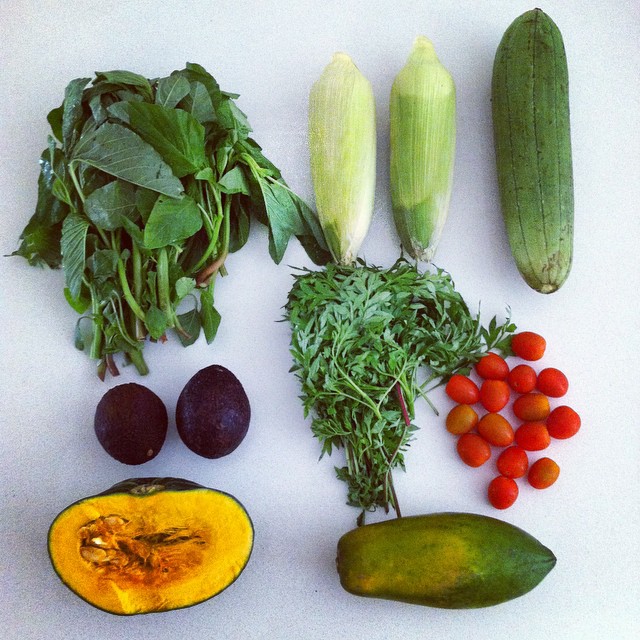
The exciting reveal of my veggie basket from Green Circle
I had a chance to test out the delivery services from Green Circle Eco Farm recently. They offer a Veggie Basket of seasonal vegetable. Each basket costs $30 (with an additional $5 for delivery) and contains approximately 7 types of vegetables or fruits.
For those who do not wish to select your own vegetables from their list or who love surprises, this is a good option to go for. Home deliveries are currently made from 2 – 10pm on Wednesdays (East of Singapore), Thursdays (Central area) and Fridays (Western side of Singapore) only. The only issue I had was I didn’t know what time I would receive my delivery. In this case, I received my basket on Wednesday at 8pm (I stay in the Siglap area) and from what I understand, subsequent delivery will be at a similar time.
It was quite exciting to see what was included in the basket. However, if you wish to maximise your grocery budget for the week, it is perhaps best to pick your own vegetables. And while organic vegetables are indeed a little more expensive, it doesn’t have to break your bank or exceed your weekly expenditure. Here’s a quick cost comparison as an illustration:
| Organic | Non-Organic | |
| Cai Xin (250g) | $2.50 | $2.04 |
| Kai Lan (250g) | $2.50 | $2.38 |
| Xia Bai Cai (250g) | $2.50 | $1.88 |
Surely, a small price to pay to know that the food you are eating is free from artificial harmful substances. While you may not be entirely convinced yet, at least consider giving it a try. After all, increasing the demand for organic farm-to-table produce may in the long run mean a better price for consumers and a cleaner lifestyle for all.
Check back for some budget farm-to-table recipes that you can cook at home, which I will be sharing over the next few weeks.
To find out how you can support the farm-to-table practice at your next party, contact us for a discussion.


 Cook In:Lab
You must be logged in to post a comment.